
Currently Empty: ৳ 0.00
Personal Development
12 Practical Tips to Power Up Your Medical Teaching
In medical education, being a subject expert isn’t enough. Today’s faculty members are expected to inspire critical thinking, engage diverse learners, and adapt to fast-evolving technologies. This calls for more than content delivery—it requires intentional teaching development. Whether you’re a new educator or a seasoned clinician, these 12 practical teaching tips and the 4C framework offer a research-based roadmap to make your teaching more impactful, especially in clinical and active learning settings.
12 Tips for Effective and Engaging Medical Teaching
Adapted from educational theory and Dennick’s work on active learning, these tips are designed for hands-on, reflective, and learner-centered teaching:
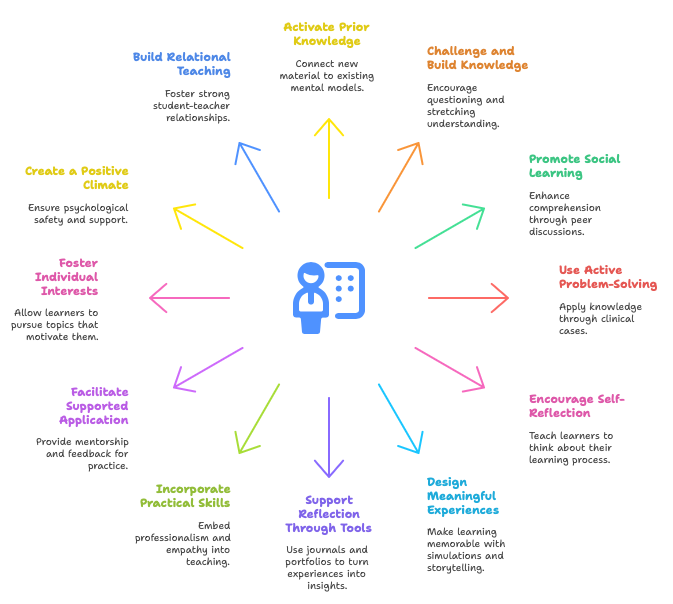
1. Activate Prior Knowledge
Start by uncovering what learners already know. This builds rapport and helps connect new material to existing mental models.
2. Challenge and Build on Knowledge
Encourage students to question their current understanding. Learning deepens when it stretches what they think they know.
3. Promote Social Learning
Group work enhances comprehension. Peer discussions help learners process unfamiliar concepts collaboratively.
4. Use Active Problem-Solving
Integrate clinical cases or problem-based tasks. Applying knowledge leads to better retention and skill development.
5. Encourage Self-Reflection
Teach learners to think about how they learn. Reflection builds autonomy and metacognition.
6. Design Meaningful Learning Experiences
Use simulation, dialogue, or storytelling to make learning memorable and contextually relevant.
7. Support Reflection Through Tools
Help students write reflections, use portfolios, or share learning journals to turn experiences into insights.
8. Incorporate Practical Skills and Attitudes
Go beyond theory—embed professionalism, communication, and empathy into teaching activities.
9. Facilitate Supported Application
Give students chances to practice what they’ve learned—paired with mentorship, feedback, or scaffolding.
10. Foster Individual Interests
Allow room for learners to pursue topics that motivate them, enhancing engagement and curiosity.
11. Create a Positive Learning Climate
Psychological safety matters. Celebrate efforts, use positive reinforcement, and design supportive environments.
12. Build Relational Teaching
A strong student–teacher relationship fosters motivation. Involve students in shaping learning strategies and curricula.
The 4Cs of Sustainable Faculty Development
To consistently deliver great teaching, educators need more than pedagogical tips—they need system-level support. The 4C Framework (Van Bruggen et al.) outlines the institutional conditions for successful faculty development:
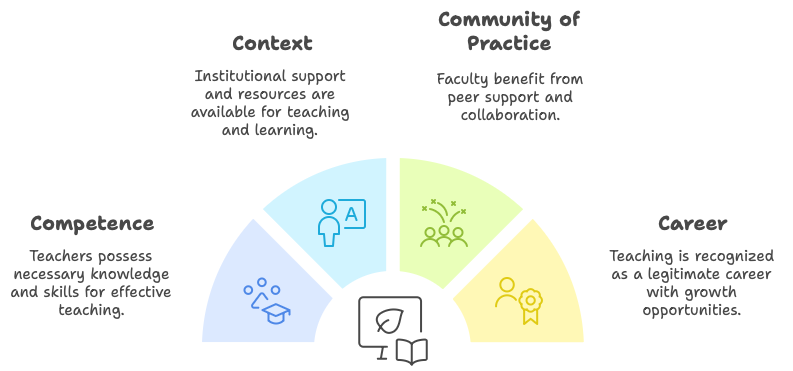
1. Competence
Teachers must have the required knowledge and pedagogical skills to teach effectively.
2. Context
This includes protected time, institutional support, and access to resources for teaching and learning.
3. Community of Practice
Faculty thrive with peer support, mentoring, collaboration, and shared experiences.
4. Career
Teaching must be recognized as a legitimate career track with clear rewards, growth, and visibility.
If any one of these areas is neglected, faculty development programs lose impact. All four must be actively cultivated for sustained success.
Faculty development isn’t about becoming perfect—it’s about being purposeful. Start with small teaching adjustments using the 12 tips, and advocate for institutional conditions that support the 4Cs. As a medical educator, your growth shapes the future of healthcare. Let’s make teaching not just an activity—but a calling, a craft, and a career.